
How to Manage Cash Flow in HVAC & Plumbing with These 5 Quick Changes
Learn how to manage cash flow in a seasonal trades business like HVAC or plumbing with five proven changes that stabilize revenue year-round.
Read more
Published
July 17, 2026
.png)
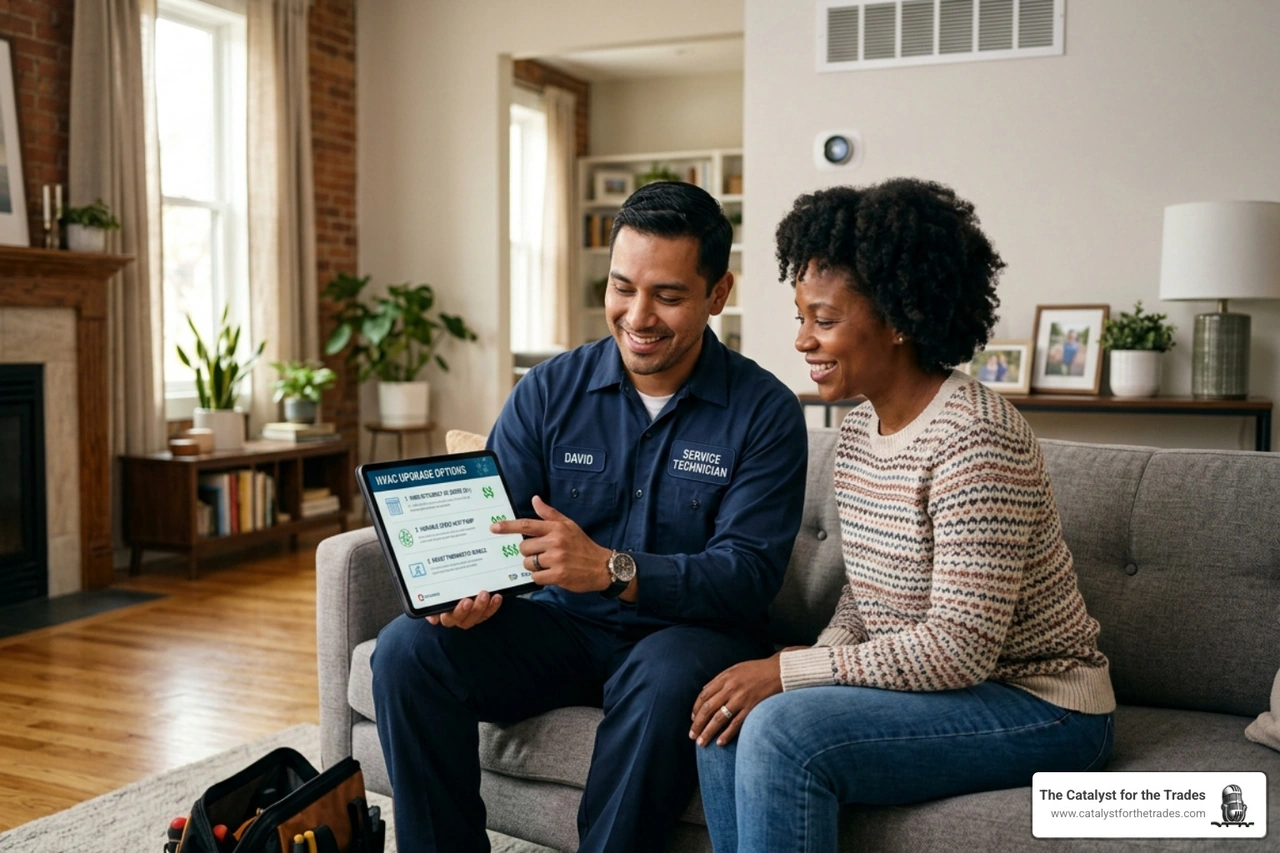
Upselling HVAC services is the practice of offering customers relevant upgrades, add-ons, or higher-tier service plans during an existing service interaction — turning a routine visit into a larger, more valuable transaction for both sides.
Quick answer: How to upsell HVAC services effectively
If you run an HVAC business, you already know that landing new customers is expensive and competitive. But the customers already in your system? You have a 60-70% chance of selling to them again — compared to just 5-20% for someone brand new. That gap is where real, scalable revenue hides.
The problem is that most HVAC businesses leave that revenue on the table. Not because their technicians aren't skilled, but because there's no consistent, structured approach to presenting upgrade options in the field. One tech mentions a smart thermostat. Another says nothing. A third oversells and damages the relationship. The result is unpredictable revenue and missed opportunities on every single truck roll.
Done right, upselling isn't pressure — it's a service. A technician who spots a failing component, an aging system, or a home with poor air quality and says nothing isn't being polite. They're leaving a homeowner uninformed about their own property. The best HVAC businesses treat upgrade conversations as part of delivering a complete, professional job.
This guide walks you through exactly how to build that approach — from identifying the right moments to training your team and tracking what's actually working.
Basic upselling hvac services terms:
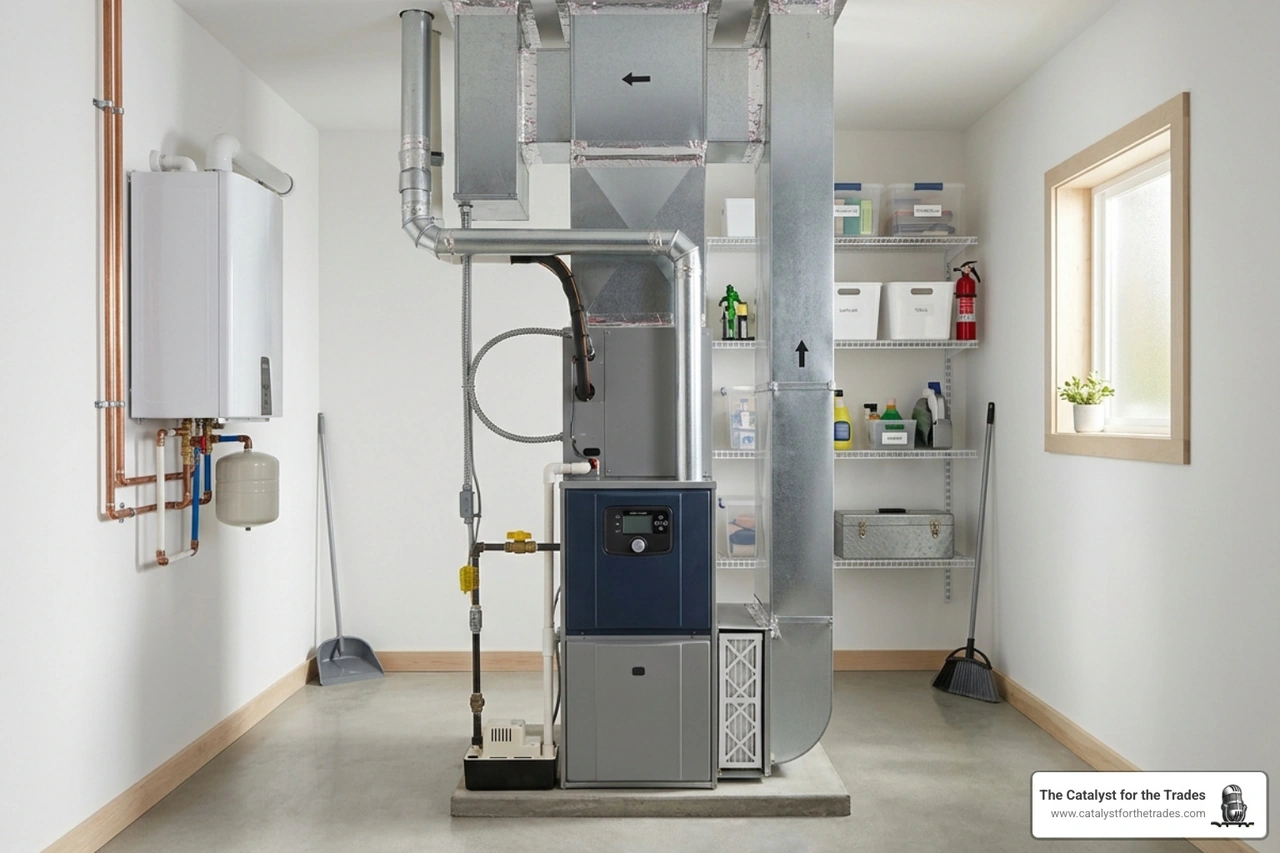
When we talk about growing an HVAC business in April 2026, many owners immediately think about buying more leads. While leads are the lifeblood of growth, the most efficient way to boost your bottom line is to maximize the value of the appointments you already have scheduled. This is where a structured program for upselling hvac services becomes a game-changer.
Research shows that companies with structured upselling and cross-selling programs see 30-50% higher revenue per customer compared to those that rely on passive order-taking. Think about that for a second. Without hiring a single new technician or buying more Google Ads, you could potentially increase your revenue by nearly half just by changing how you communicate with your existing clients.
Upselling isn't just about the top-line number; it’s about the profit margin. When a technician is already on-site, the "customer acquisition cost" for that visit has already been paid. The truck is in the driveway, the gas has been spent, and the technician's hourly rate is already being billed. Any additional service or upgrade sold during that visit—whether it’s a surge protector, a smart thermostat, or an Indoor Air Quality (IAQ) system—carries a much higher profit margin because the overhead is already covered.
It sounds counterintuitive to some, but upselling actually improves customer retention. Data indicates that boosting customer retention by just 5% can increase profits by 25-95%. Why? Because a customer who has a high-efficiency system, a smart thermostat, and a solid maintenance plan is a customer who experiences fewer breakdowns and lower energy bills. They see us as partners in their home comfort rather than just the "emergency guy" they call when things break.
By offering upgrades, we are helping the customer utilize their resources better. For instance, regular HVAC maintenance can reduce energy bills by up to 30%. When we present that to a homeowner, we aren't just selling a plan; we are selling a 30% reduction in their monthly overhead. That is a powerful competitive advantage. For more on how these moving parts fit together, check out our Hvac Business Operations Guide.
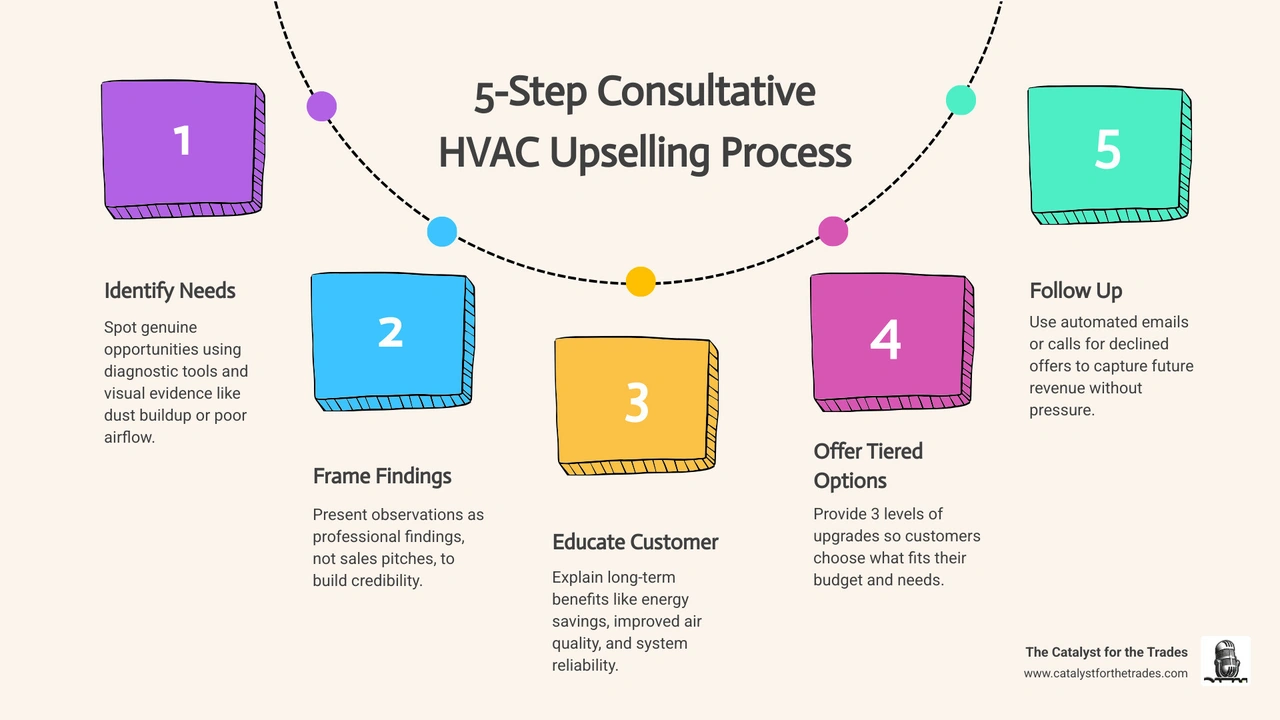
The biggest mistake a technician can make is walking into a home with a "sales first" mindset. Homeowners can smell a pitch from a mile away, and in 2026, they have zero patience for it. To be successful, we must train our teams to look for indicators—physical and verbal cues that suggest a legitimate need for an upgrade.
One of the most effective ways to identify and present opportunities is through visual proof. As discussed in The Power Of Choice Why Menu Pricing Changes Everything With Danielle Putnam, giving the customer a choice based on what they can see with their own eyes changes the dynamic.
Instead of saying, "Your ducts are dirty," show them a photo of the buildup inside their own vents. Instead of saying, "Your capacitor is weak," show them the reading on your multimeter compared to the manufacturer's specs. When the customer sees the evidence, the "upsell" stops being a suggestion and starts being a logical solution to a visible problem.
Ethical upselling is built on the foundation of consultative selling. This means we aren't "selling" at all—we are advising. We are the experts who understand the complex machinery that keeps their family safe and comfortable.
The goal is to move away from "Would you like to buy this?" and toward "I noticed X, and here is how it affects Y." For example, "I noticed your system is pulling more amps than it should, which is likely why your energy bills have been creeping up. I’d recommend a hard-start kit to protect the compressor and lower that draw."
This level of transparency builds trust. If a customer feels you are looking out for their wallet in the long run, they are much more likely to say yes. For a deeper dive into these methods, see our guide on Closing Techniques For Hvac Sales.
Providing choices is essential. When you present a single option, the customer's choice is "Yes" or "No." When you present three options (Basic Repair, Enhanced Performance, and Premium Reliability), the choice becomes "Which one is best for my family?"
This is the core of Sales Training Contractors should prioritize. It empowers the customer and removes the feeling of being pushed into a corner. 51% of customers prioritize value over price when making a purchase decision. By showing them the value of the "Best" option, you often find they are willing to invest more for peace of mind.
Every interaction is an opportunity, but some are more "fertile" than others:
As we emphasize in Stop Chasing New Leads Start Closing The Ones You Already Have, the fortune is in the follow-up. If a customer declines an upgrade on-site, don't just forget about it. Tag it in your CRM and send a personalized follow-up email three days later with more information on the benefits.
Technicians are often hesitant to "sell" because they don't want to be perceived as pushy. We need to shift the culture from "selling" to "serving."
In From Fitness Sales To Hvac Legend Building A Modern Sales Culture With Darren Tyler Dixon, we explore how a sales culture is built on confidence and communication. Training should include:
| Feature | Verbal Recommendation | Digital Visual Presentation |
|---|---|---|
| Trust Level | Moderate (Depends on tech's rapport) | High (Data-driven and transparent) |
| Close Rate | Average | 3x Higher than verbal |
| Average Ticket | Lower | 40% Higher per visit |
| Follow-up | Often forgotten | Automated and tracked in CRM |
The most important thing is to listen. Don't interrupt. If a customer says it’s too expensive, they are usually saying they don't see the value yet. Re-emphasize the long-term savings—like how a smart thermostat pays for itself in 12-18 months through energy savings. If they still decline, respect the "no" and ask if you can send them some information to look over later. This keeps the door open without damaging the relationship.
You can't manage what you don't measure. Key metrics include:
Absolutely, provided it is based on genuine findings. In fact, we argue it is unethical to withhold information that could save a customer money or improve their health. If a technician sees a cracked heat exchanger and doesn't recommend a replacement, they are putting the family at risk. If they see a system that is wasting 40% of its energy and don't suggest a high-efficiency upgrade, they are allowing the customer to lose money. Reporting deficiencies and offering solutions is the highest form of customer service.
At The Catalyst for the Trades, we believe that the difference between a struggling service company and a market leader is the mindset of the team. Upselling hvac services isn't a "trick"—it's a sophisticated strategy for growth, innovation, and leadership.
By shifting your culture to one of consultative expertise, you aren't just increasing your revenue; you're building a more resilient business that provides more value to every home it touches. From the gym floor to the mechanical room, the principles of professional sales remain the same: build trust, provide value, and give the customer the power of choice.
To hear more about transforming your service team into a powerhouse of growth, listen to our episode From Gym Floors To Hvac Superstar Tyler Dixons Leap Into Trades Sales.
Learn more about our mission to empower the trades and start scaling your operations today.

Discover how leading home‑service companies are leveraging AI, subscription models, and digital‑first strategies.

Learn why private equity, automation, and customer‑centric tech are reshaping the trades.


Learn how to manage cash flow in a seasonal trades business like HVAC or plumbing with five proven changes that stabilize revenue year-round.

Learn how to build a home service website that converts visitors into booked jobs with proven strategies that boost leads and reduce bounce rates.

Discover how the communication style of your technicians affects customer retention and learn proven strategies to boost loyalty and reduce churn.
.webp)