Episode
October 21, 2025

What is Management Development? Empowering Your Team's Potential

Why Management Development Is Your Secret Weapon for Business Growth

Management development is the systematic process of improving your managers' skills and preparing them for bigger roles. It's not just training—it's building the backbone of your business by focusing on leadership, people management, and business acumen.

Here's a statistic that should grab your attention: companies with talented managers see 147% higher earnings per share than their competition, according to Gallup research. Yet, 59% of employees don't see any leaders at their company they want to become. That gap is your opportunity.

In the home services industry, strong managers are the difference between a business that survives and one that thrives. They keep technicians motivated, customers happy, and operations running smoothly. The problem is, most managers learn through trial and error. Management development changes that by giving your people the tools to lead effectively from day one. For any plumbing, HVAC, or electrical business, investing in your managers directly impacts your bottom line.
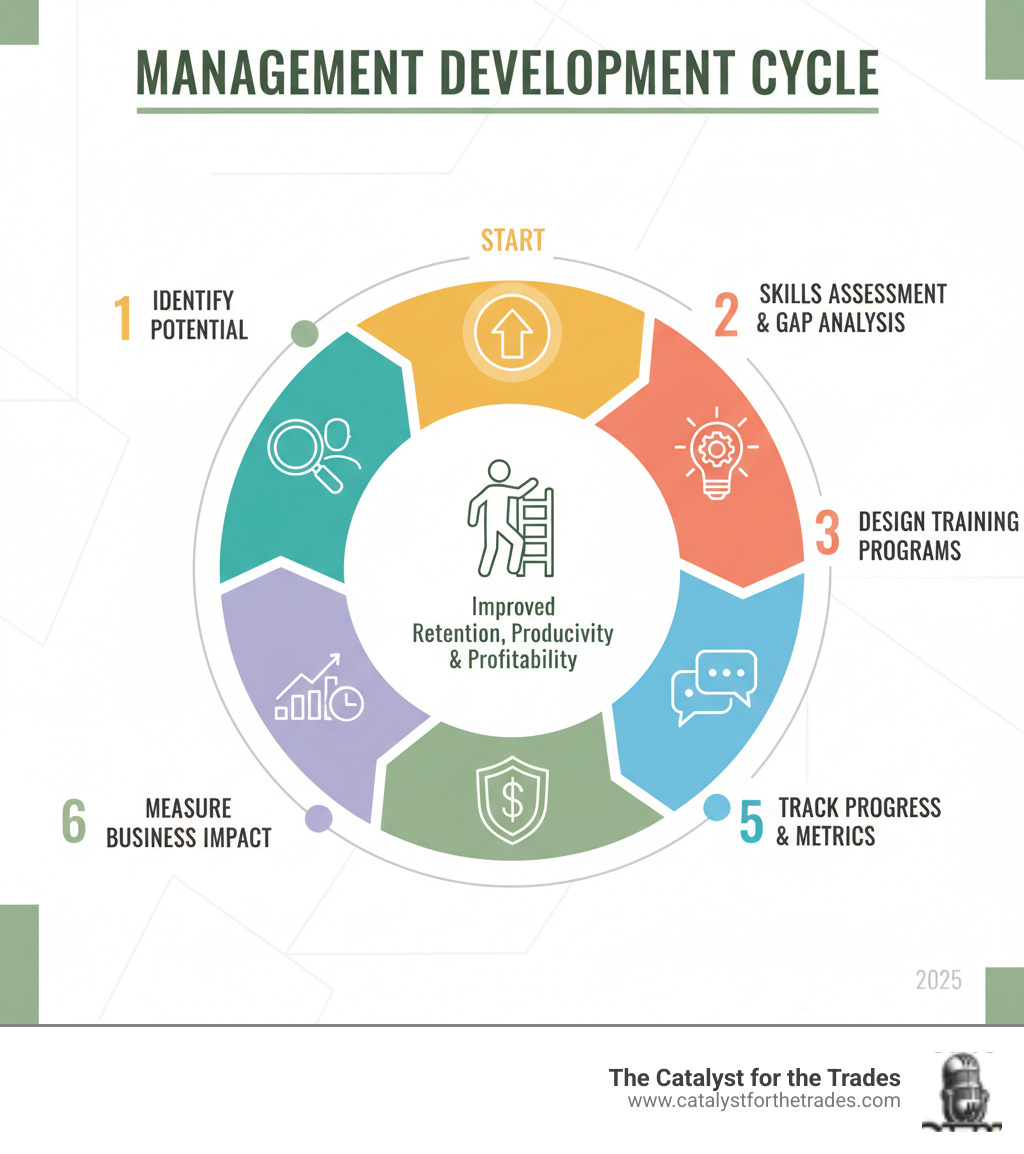
Comprehensive infographic showing the management development cycle: starting with identifying high-potential employees, moving through skills assessment and gap analysis, then to designing targeted training programs, implementing coaching and mentoring, tracking progress and performance metrics, and finally measuring business impact through improved retention, productivity, and profitability - management development infographic

Why Invest in Management Development? The Unmistakable ROI

When you invest in management development, you're making a strategic bet that pays dividends. In the home services world, where every job and customer interaction counts, strong managers are the difference between struggling and growing year after year.

Imagine if all your managers operated at the level of your best one—handling problems before they become crises and keeping teams motivated. That's what management development can do for your business.

Of course, getting a program off the ground has challenges, like upfront costs and time investment. You might even face resistance from team members. But these problems are temporary, while the benefits last for years.

an engaged team collaborating on a project plan - management development

The Tangible Benefits of Strong Management

Strong managers impact your bottom line in several ways:

  • Higher earnings per share: Efficient resource allocation, waste reduction, and on-time project completion boost profitability.
  • Lower employee turnover: Good managers are a primary reason employees stay. Replacing a skilled technician can cost thousands, so reducing turnover offers immediate savings.
  • Improved employee engagement: Engaged employees are more productive, innovative, and provide better customer service.
  • Better customer satisfaction: Well-managed technicians deliver professional, efficient service, leading to repeat business and referrals.
  • Succession planning: Consistently developing managers creates a pipeline of qualified internal candidates ready to step up.
  • Building human capital: The skills your managers develop become a long-term competitive advantage for your company.

For a great example of how this people-first approach drives real growth, check out our insights on people-first leadership.

Common Problems in Program Implementation

Even with clear benefits, implementation can be tricky. Research by CIPD found that only 40% of organizations have programs to improve managers' people skills, and about 25% of managers have never received any management training.

Common obstacles include:

  • Budget constraints: The upfront cost can seem high, but it's often less than the cost of high turnover and low productivity.
  • Lack of senior management support: If leadership isn't bought in, the program will be seen as unimportant.
  • Inadequate needs analysis: Generic, one-size-fits-all training rarely addresses the specific challenges your managers face.
  • Failure to integrate with business goals: Training must be directly linked to improving service, increasing efficiency, or supporting growth.
  • Resistance to change: People are comfortable with the status quo. Overcome this with clear communication about the benefits for them and the business.

Recognizing these challenges upfront is the first step to overcoming them.

The Modern Manager's Toolkit: Essential Skills and Competencies

The truth about management development in home services is that your best technician won't automatically become your best manager. The roles require different skills.

Modern managers need a balanced skill set that blends people-focused abilities (soft skills) with business-focused competencies (hard skills). These transferable skills are crucial whether managing a small team or planning next quarter's growth.

a manager leading a training session in an office setting - management development

Core Leadership and People Skills

These skills are the foundation of great management, especially in a customer-facing industry like home services.

  • Communication and Active Listening: Clearly explain job requirements, give helpful feedback, and truly hear what team members are saying.
  • Emotional Intelligence: Read the room, stay calm under pressure, and manage the emotional ups and downs of service work.
  • Conflict Resolution: Address disagreements and customer complaints constructively before they escalate.
  • Performance Management: Set clear expectations, check in regularly, and help team members improve.
  • Coaching and Mentoring: Ask questions that help your team solve problems and grow their own skills.
  • Team Building and Motivation: Create a workplace where people feel valued and work toward common goals.

For more insights on creating teams that drive real growth, check out our guide on building a team that drives growth.

Operational and Strategic Skills for the Trades

These skills help managers drive business results, ensuring services are delivered efficiently and profitably.

  • Financial Acumen: Understand how pricing, efficiency, and daily decisions impact the company's financial health.
  • Project Management: Keep jobs on schedule and on budget by managing technicians, materials, and timelines.
  • Change Management: Help teams adapt to new technologies, regulations, and customer expectations without losing momentum.
  • Strategic Thinking: See beyond the daily schedule to identify trends, anticipate problems, and contribute to long-term growth.
  • Decision-Making: Gather information quickly, weigh options, and make sound choices, especially under pressure.
  • Understanding Business Metrics: Use data to identify opportunities for improvement and track progress toward company goals.

Want to see how these skills work in practice? Learn from someone who scaled a business to $100 million in our insights on scaling a home services company.

When managers combine strong people leadership with solid operational skills, management development really pays off.

Building Your High-Impact Management Development Program

Creating a management development program is a strategic process. It starts with understanding your current needs and aligning your efforts with your business objectives. You need to identify what skills your managers need, choose the most effective training methods, and decide how you'll measure success.

The first step is a thorough needs assessment to evaluate your team's current skills and identify gaps. With that clarity, you can build a structured plan, secure leadership buy-in, and select the right candidates.

a strategic roadmap for a development program - management development

Types of Management Development Programs

Effective programs often blend on-the-job and off-the-job training methods to cater to different learning styles.

Method TypeExamplesDescription
On-the-Job TrainingCoaching, mentoring, job rotation, special assignments.Learning through practical, hands-on experience in the actual work environment. It's highly relevant and allows for immediate application of new skills.
Off-the-Job TrainingFormal education, workshops, online learning, simulations.Learning that takes place away from the work environment. This allows for focused, structured instruction without daily job pressures.

Best practices for a successful management development strategy

A successful strategy is integrated into your company's talent management and succession planning.

  1. Start with a Skills Gap Analysis: Assess your team's current skills to identify where development is needed most.
  2. Define Clear Objectives: Set SMART (Specific, Measurable, Achievable, Relevant, Time-bound) goals for your program.
  3. Customize Content: Tailor training to your industry, company culture, and the specific challenges your managers face.
  4. Blend Learning Methods: Use a mix of formal training, coaching, and on-the-job experiences to accommodate different learning styles.
  5. Implement and Track Progress: Roll out the program and monitor participation and feedback to maintain momentum.
  6. Adjust and Refine Based on Feedback: Regularly gather feedback to improve the program and ensure it meets evolving business needs.
  7. Integrate with Succession Planning: Use the program to build a pipeline of future leaders, ensuring long-term stability and growth.

To hear from an expert on scaling and leadership, tune into our podcast with George Donaldson.

How to Select Candidates for Development

Choosing the right people is as important as the program itself. Look for high-potential employees with the drive to lead.

  1. Identifying High-Potential Employees: Look for individuals who show initiative, problem-solving skills, and a natural tendency to help others.
  2. Performance Reviews: Review past performance for signs of leadership potential, collaboration, and a desire to learn.
  3. 360-Degree Feedback: Gather input from peers, subordinates, and superiors to get a well-rounded view of a candidate's abilities.
  4. Assessment Centers: Use simulations and role-playing to evaluate leadership competencies in a controlled environment.
  5. Psychological Traits: Look for traits like self-reliance, trustworthiness, and a strong ethical compass.
  6. Motivation to Lead: Ensure the candidate genuinely wants to manage people and take on leadership responsibilities.

To learn about a journey from the call center to the C-suite, read about Denise Swafford's impressive career path.

Measuring What Matters: ROI and The Role of HR

If you can't prove your management development programs are working, you're just guessing. Smart businesses measure their investments, and management development is no different. The goal is to connect better management skills to better business results.

Think of it like investing in new equipment: you expect to see improved efficiency. The same principle applies here. We should be able to point to concrete improvements in team performance, customer satisfaction, and the bottom line.

How to Measure the Success and ROI of Your Program

The key is linking training directly to business outcomes. Kirkpatrick's Four-Level Training Evaluation Model provides a solid framework:

  1. Level 1 - Reaction: Did managers find the training engaging and relevant? Use post-training surveys to gauge their initial response.
  2. Level 2 - Learning: Can managers demonstrate the new skills? Pre- and post-training assessments or role-playing can measure knowledge transfer.
  3. Level 3 - Behavior: Are managers using their new skills on the job? Observe them, use performance reviews, and gather team feedback.
  4. Level 4 - Results: Did the training impact business outcomes? Connect the program to improvements in revenue, profitability, and efficiency.

Beyond this model, track metrics that matter in your industry:

  • Employee pulse surveys can show changes in team morale and engagement.
  • Manager performance reviews should focus on the specific competencies targeted in the training.
  • Retention and promotion rates indicate if you're developing and keeping top talent.
  • Team productivity and efficiency can be seen in faster job completion and fewer errors.
  • Financial impact is the ultimate measure. Connect improved management to increased revenue or reduced costs to prove ROI.

The Strategic Role of HR in Facilitating Growth

HR is the strategic engine that drives management development. They see the big picture, connecting individual development with organizational goals.

  • Program Design and Management: HR assesses needs, designs relevant curriculum, and coordinates the entire program.
  • Facilitating Training: They ensure the learning experience is engaging and applicable to daily challenges.
  • Ensuring Legal Compliance: HR makes sure programs meet all labor law requirements, protecting the company and its employees.
  • Supporting Managers Post-Training: They provide ongoing coaching, resources, and follow-up to help managers apply new skills.
  • Championing a Culture of Learning: HR helps leadership understand the value of development and makes continuous growth part of the company's DNA.

When HR takes a strategic approach, they become partners in growth, building the leadership pipeline for the future.

For insights on building people-centered companies, check out our conversation with Raul Rodriguez, who shares 40 years of wisdom on leading and growing in the trades.

Frequently Asked Questions about Management Development

Running a home service business means dealing with real challenges every day. When it comes to management development, we know you have questions—and we've got answers that work in the real world.

What's the first step for a small business to start developing managers?

For a small business, a full management development program can seem daunting. The key is to start small and focus.

  • Identify one or two key skills that will have the biggest immediate impact, like communication or conflict resolution.
  • Use coaching and mentoring. Pairing a new manager with an experienced leader is a low-cost, high-impact strategy.
  • Leverage free and low-cost resources. There are many quality articles, videos, and online courses available.
  • Lead by example. The leadership behaviors you demonstrate are the most powerful training tool you have.

Can you develop managers who don't have "natural" leadership qualities?

Yes. Management is a skill, and skills can be taught. The idea of a "natural-born leader" is mostly a myth. While some people have a natural inclination, anyone can learn to be an effective manager with the right training and practice.

Focus on teachable competencies like process management, communication techniques, and strategic planning. A person's personality is just one piece of the puzzle. With the right tools, even the most unlikely candidates can become outstanding managers by leveraging their unique strengths.

How do you keep managers engaged in their own development?

Busy managers will only engage in development that feels relevant and rewarding.

  • Connect development to career advancement. Show a clear path from training to promotion.
  • Offer a variety of learning methods. Let managers choose from workshops, online courses, mentoring, or special projects that fit their style.
  • Ensure senior leadership participates. When executives model continuous learning, it sends a powerful message.
  • Make it practical. Give managers real-world projects where they can immediately apply their new skills.

When development feels like an investment in their future, not just another task, engagement will follow.

Conclusion: Build Your Leadership Pipeline for a Stronger Future

In the end, management development isn't just another business expense—it's your secret weapon for building a thriving home service company. The evidence is clear: companies with talented managers see 147% higher earnings per share. That's the direct result of investing in your people.

By blending people skills with operational expertise, you create leaders who can handle any challenge. This investment impacts every part of your business, from better employee retention and improved productivity to a stronger company culture that attracts top talent.

You don't have to start with a massive program. Begin with coaching, focus on one or two critical skills, and build from there. Your future leaders are already on your team, waiting for the opportunity to grow.

Investing in your people is an investment in your future. It's how you build a leadership pipeline that ensures your business thrives for years to come. At The Catalyst for the Trades, we've seen how this strategy transforms good companies into great ones.

The question isn't whether you can afford to invest in management development—it's whether you can afford not to.

Explore more strategies for growth and leadership in the trades.

Why Management Development Is Your Secret Weapon for Business Growth

Management development is the systematic process of improving your managers' skills and preparing them for bigger roles. It's not just training—it's building the backbone of your business by focusing on leadership, people management, and business acumen.

Here's a statistic that should grab your attention: companies with talented managers see 147% higher earnings per share than their competition, according to Gallup research. Yet, 59% of employees don't see any leaders at their company they want to become. That gap is your opportunity.

In the home services industry, strong managers are the difference between a business that survives and one that thrives. They keep technicians motivated, customers happy, and operations running smoothly. The problem is, most managers learn through trial and error. Management development changes that by giving your people the tools to lead effectively from day one. For any plumbing, HVAC, or electrical business, investing in your managers directly impacts your bottom line.

Comprehensive infographic showing the management development cycle: starting with identifying high-potential employees, moving through skills assessment and gap analysis, then to designing targeted training programs, implementing coaching and mentoring, tracking progress and performance metrics, and finally measuring business impact through improved retention, productivity, and profitability - management development infographic

Why Invest in Management Development? The Unmistakable ROI

When you invest in management development, you're making a strategic bet that pays dividends. In the home services world, where every job and customer interaction counts, strong managers are the difference between struggling and growing year after year.

Imagine if all your managers operated at the level of your best one—handling problems before they become crises and keeping teams motivated. That's what management development can do for your business.

Of course, getting a program off the ground has challenges, like upfront costs and time investment. You might even face resistance from team members. But these problems are temporary, while the benefits last for years.

an engaged team collaborating on a project plan - management development

The Tangible Benefits of Strong Management

Strong managers impact your bottom line in several ways:

  • Higher earnings per share: Efficient resource allocation, waste reduction, and on-time project completion boost profitability.
  • Lower employee turnover: Good managers are a primary reason employees stay. Replacing a skilled technician can cost thousands, so reducing turnover offers immediate savings.
  • Improved employee engagement: Engaged employees are more productive, innovative, and provide better customer service.
  • Better customer satisfaction: Well-managed technicians deliver professional, efficient service, leading to repeat business and referrals.
  • Succession planning: Consistently developing managers creates a pipeline of qualified internal candidates ready to step up.
  • Building human capital: The skills your managers develop become a long-term competitive advantage for your company.

For a great example of how this people-first approach drives real growth, check out our insights on people-first leadership.

Common Problems in Program Implementation

Even with clear benefits, implementation can be tricky. Research by CIPD found that only 40% of organizations have programs to improve managers' people skills, and about 25% of managers have never received any management training.

Common obstacles include:

  • Budget constraints: The upfront cost can seem high, but it's often less than the cost of high turnover and low productivity.
  • Lack of senior management support: If leadership isn't bought in, the program will be seen as unimportant.
  • Inadequate needs analysis: Generic, one-size-fits-all training rarely addresses the specific challenges your managers face.
  • Failure to integrate with business goals: Training must be directly linked to improving service, increasing efficiency, or supporting growth.
  • Resistance to change: People are comfortable with the status quo. Overcome this with clear communication about the benefits for them and the business.

Recognizing these challenges upfront is the first step to overcoming them.

The Modern Manager's Toolkit: Essential Skills and Competencies

The truth about management development in home services is that your best technician won't automatically become your best manager. The roles require different skills.

Modern managers need a balanced skill set that blends people-focused abilities (soft skills) with business-focused competencies (hard skills). These transferable skills are crucial whether managing a small team or planning next quarter's growth.

a manager leading a training session in an office setting - management development

Core Leadership and People Skills

These skills are the foundation of great management, especially in a customer-facing industry like home services.

  • Communication and Active Listening: Clearly explain job requirements, give helpful feedback, and truly hear what team members are saying.
  • Emotional Intelligence: Read the room, stay calm under pressure, and manage the emotional ups and downs of service work.
  • Conflict Resolution: Address disagreements and customer complaints constructively before they escalate.
  • Performance Management: Set clear expectations, check in regularly, and help team members improve.
  • Coaching and Mentoring: Ask questions that help your team solve problems and grow their own skills.
  • Team Building and Motivation: Create a workplace where people feel valued and work toward common goals.

For more insights on creating teams that drive real growth, check out our guide on building a team that drives growth.

Operational and Strategic Skills for the Trades

These skills help managers drive business results, ensuring services are delivered efficiently and profitably.

  • Financial Acumen: Understand how pricing, efficiency, and daily decisions impact the company's financial health.
  • Project Management: Keep jobs on schedule and on budget by managing technicians, materials, and timelines.
  • Change Management: Help teams adapt to new technologies, regulations, and customer expectations without losing momentum.
  • Strategic Thinking: See beyond the daily schedule to identify trends, anticipate problems, and contribute to long-term growth.
  • Decision-Making: Gather information quickly, weigh options, and make sound choices, especially under pressure.
  • Understanding Business Metrics: Use data to identify opportunities for improvement and track progress toward company goals.

Want to see how these skills work in practice? Learn from someone who scaled a business to $100 million in our insights on scaling a home services company.

When managers combine strong people leadership with solid operational skills, management development really pays off.

Building Your High-Impact Management Development Program

Creating a management development program is a strategic process. It starts with understanding your current needs and aligning your efforts with your business objectives. You need to identify what skills your managers need, choose the most effective training methods, and decide how you'll measure success.

The first step is a thorough needs assessment to evaluate your team's current skills and identify gaps. With that clarity, you can build a structured plan, secure leadership buy-in, and select the right candidates.

a strategic roadmap for a development program - management development

Types of Management Development Programs

Effective programs often blend on-the-job and off-the-job training methods to cater to different learning styles.

Method TypeExamplesDescription
On-the-Job TrainingCoaching, mentoring, job rotation, special assignments.Learning through practical, hands-on experience in the actual work environment. It's highly relevant and allows for immediate application of new skills.
Off-the-Job TrainingFormal education, workshops, online learning, simulations.Learning that takes place away from the work environment. This allows for focused, structured instruction without daily job pressures.

Best practices for a successful management development strategy

A successful strategy is integrated into your company's talent management and succession planning.

  1. Start with a Skills Gap Analysis: Assess your team's current skills to identify where development is needed most.
  2. Define Clear Objectives: Set SMART (Specific, Measurable, Achievable, Relevant, Time-bound) goals for your program.
  3. Customize Content: Tailor training to your industry, company culture, and the specific challenges your managers face.
  4. Blend Learning Methods: Use a mix of formal training, coaching, and on-the-job experiences to accommodate different learning styles.
  5. Implement and Track Progress: Roll out the program and monitor participation and feedback to maintain momentum.
  6. Adjust and Refine Based on Feedback: Regularly gather feedback to improve the program and ensure it meets evolving business needs.
  7. Integrate with Succession Planning: Use the program to build a pipeline of future leaders, ensuring long-term stability and growth.

To hear from an expert on scaling and leadership, tune into our podcast with George Donaldson.

How to Select Candidates for Development

Choosing the right people is as important as the program itself. Look for high-potential employees with the drive to lead.

  1. Identifying High-Potential Employees: Look for individuals who show initiative, problem-solving skills, and a natural tendency to help others.
  2. Performance Reviews: Review past performance for signs of leadership potential, collaboration, and a desire to learn.
  3. 360-Degree Feedback: Gather input from peers, subordinates, and superiors to get a well-rounded view of a candidate's abilities.
  4. Assessment Centers: Use simulations and role-playing to evaluate leadership competencies in a controlled environment.
  5. Psychological Traits: Look for traits like self-reliance, trustworthiness, and a strong ethical compass.
  6. Motivation to Lead: Ensure the candidate genuinely wants to manage people and take on leadership responsibilities.

To learn about a journey from the call center to the C-suite, read about Denise Swafford's impressive career path.

Measuring What Matters: ROI and The Role of HR

If you can't prove your management development programs are working, you're just guessing. Smart businesses measure their investments, and management development is no different. The goal is to connect better management skills to better business results.

Think of it like investing in new equipment: you expect to see improved efficiency. The same principle applies here. We should be able to point to concrete improvements in team performance, customer satisfaction, and the bottom line.

How to Measure the Success and ROI of Your Program

The key is linking training directly to business outcomes. Kirkpatrick's Four-Level Training Evaluation Model provides a solid framework:

  1. Level 1 - Reaction: Did managers find the training engaging and relevant? Use post-training surveys to gauge their initial response.
  2. Level 2 - Learning: Can managers demonstrate the new skills? Pre- and post-training assessments or role-playing can measure knowledge transfer.
  3. Level 3 - Behavior: Are managers using their new skills on the job? Observe them, use performance reviews, and gather team feedback.
  4. Level 4 - Results: Did the training impact business outcomes? Connect the program to improvements in revenue, profitability, and efficiency.

Beyond this model, track metrics that matter in your industry:

  • Employee pulse surveys can show changes in team morale and engagement.
  • Manager performance reviews should focus on the specific competencies targeted in the training.
  • Retention and promotion rates indicate if you're developing and keeping top talent.
  • Team productivity and efficiency can be seen in faster job completion and fewer errors.
  • Financial impact is the ultimate measure. Connect improved management to increased revenue or reduced costs to prove ROI.

The Strategic Role of HR in Facilitating Growth

HR is the strategic engine that drives management development. They see the big picture, connecting individual development with organizational goals.

  • Program Design and Management: HR assesses needs, designs relevant curriculum, and coordinates the entire program.
  • Facilitating Training: They ensure the learning experience is engaging and applicable to daily challenges.
  • Ensuring Legal Compliance: HR makes sure programs meet all labor law requirements, protecting the company and its employees.
  • Supporting Managers Post-Training: They provide ongoing coaching, resources, and follow-up to help managers apply new skills.
  • Championing a Culture of Learning: HR helps leadership understand the value of development and makes continuous growth part of the company's DNA.

When HR takes a strategic approach, they become partners in growth, building the leadership pipeline for the future.

For insights on building people-centered companies, check out our conversation with Raul Rodriguez, who shares 40 years of wisdom on leading and growing in the trades.

Frequently Asked Questions about Management Development

Running a home service business means dealing with real challenges every day. When it comes to management development, we know you have questions—and we've got answers that work in the real world.

What's the first step for a small business to start developing managers?

For a small business, a full management development program can seem daunting. The key is to start small and focus.

  • Identify one or two key skills that will have the biggest immediate impact, like communication or conflict resolution.
  • Use coaching and mentoring. Pairing a new manager with an experienced leader is a low-cost, high-impact strategy.
  • Leverage free and low-cost resources. There are many quality articles, videos, and online courses available.
  • Lead by example. The leadership behaviors you demonstrate are the most powerful training tool you have.

Can you develop managers who don't have "natural" leadership qualities?

Yes. Management is a skill, and skills can be taught. The idea of a "natural-born leader" is mostly a myth. While some people have a natural inclination, anyone can learn to be an effective manager with the right training and practice.

Focus on teachable competencies like process management, communication techniques, and strategic planning. A person's personality is just one piece of the puzzle. With the right tools, even the most unlikely candidates can become outstanding managers by leveraging their unique strengths.

How do you keep managers engaged in their own development?

Busy managers will only engage in development that feels relevant and rewarding.

  • Connect development to career advancement. Show a clear path from training to promotion.
  • Offer a variety of learning methods. Let managers choose from workshops, online courses, mentoring, or special projects that fit their style.
  • Ensure senior leadership participates. When executives model continuous learning, it sends a powerful message.
  • Make it practical. Give managers real-world projects where they can immediately apply their new skills.

When development feels like an investment in their future, not just another task, engagement will follow.

Conclusion: Build Your Leadership Pipeline for a Stronger Future

In the end, management development isn't just another business expense—it's your secret weapon for building a thriving home service company. The evidence is clear: companies with talented managers see 147% higher earnings per share. That's the direct result of investing in your people.

By blending people skills with operational expertise, you create leaders who can handle any challenge. This investment impacts every part of your business, from better employee retention and improved productivity to a stronger company culture that attracts top talent.

You don't have to start with a massive program. Begin with coaching, focus on one or two critical skills, and build from there. Your future leaders are already on your team, waiting for the opportunity to grow.

Investing in your people is an investment in your future. It's how you build a leadership pipeline that ensures your business thrives for years to come. At The Catalyst for the Trades, we've seen how this strategy transforms good companies into great ones.

The question isn't whether you can afford to invest in management development—it's whether you can afford not to.

Explore more strategies for growth and leadership in the trades.

Why Management Development Is Your Secret Weapon for Business Growth

Management development is the systematic process of improving your managers' skills and preparing them for bigger roles. It's not just training—it's building the backbone of your business by focusing on leadership, people management, and business acumen.

Here's a statistic that should grab your attention: companies with talented managers see 147% higher earnings per share than their competition, according to Gallup research. Yet, 59% of employees don't see any leaders at their company they want to become. That gap is your opportunity.

In the home services industry, strong managers are the difference between a business that survives and one that thrives. They keep technicians motivated, customers happy, and operations running smoothly. The problem is, most managers learn through trial and error. Management development changes that by giving your people the tools to lead effectively from day one. For any plumbing, HVAC, or electrical business, investing in your managers directly impacts your bottom line.

Comprehensive infographic showing the management development cycle: starting with identifying high-potential employees, moving through skills assessment and gap analysis, then to designing targeted training programs, implementing coaching and mentoring, tracking progress and performance metrics, and finally measuring business impact through improved retention, productivity, and profitability - management development infographic

Why Invest in Management Development? The Unmistakable ROI

When you invest in management development, you're making a strategic bet that pays dividends. In the home services world, where every job and customer interaction counts, strong managers are the difference between struggling and growing year after year.

Imagine if all your managers operated at the level of your best one—handling problems before they become crises and keeping teams motivated. That's what management development can do for your business.

Of course, getting a program off the ground has challenges, like upfront costs and time investment. You might even face resistance from team members. But these problems are temporary, while the benefits last for years.

an engaged team collaborating on a project plan - management development

The Tangible Benefits of Strong Management

Strong managers impact your bottom line in several ways:

  • Higher earnings per share: Efficient resource allocation, waste reduction, and on-time project completion boost profitability.
  • Lower employee turnover: Good managers are a primary reason employees stay. Replacing a skilled technician can cost thousands, so reducing turnover offers immediate savings.
  • Improved employee engagement: Engaged employees are more productive, innovative, and provide better customer service.
  • Better customer satisfaction: Well-managed technicians deliver professional, efficient service, leading to repeat business and referrals.
  • Succession planning: Consistently developing managers creates a pipeline of qualified internal candidates ready to step up.
  • Building human capital: The skills your managers develop become a long-term competitive advantage for your company.

For a great example of how this people-first approach drives real growth, check out our insights on people-first leadership.

Common Problems in Program Implementation

Even with clear benefits, implementation can be tricky. Research by CIPD found that only 40% of organizations have programs to improve managers' people skills, and about 25% of managers have never received any management training.

Common obstacles include:

  • Budget constraints: The upfront cost can seem high, but it's often less than the cost of high turnover and low productivity.
  • Lack of senior management support: If leadership isn't bought in, the program will be seen as unimportant.
  • Inadequate needs analysis: Generic, one-size-fits-all training rarely addresses the specific challenges your managers face.
  • Failure to integrate with business goals: Training must be directly linked to improving service, increasing efficiency, or supporting growth.
  • Resistance to change: People are comfortable with the status quo. Overcome this with clear communication about the benefits for them and the business.

Recognizing these challenges upfront is the first step to overcoming them.

The Modern Manager's Toolkit: Essential Skills and Competencies

The truth about management development in home services is that your best technician won't automatically become your best manager. The roles require different skills.

Modern managers need a balanced skill set that blends people-focused abilities (soft skills) with business-focused competencies (hard skills). These transferable skills are crucial whether managing a small team or planning next quarter's growth.

a manager leading a training session in an office setting - management development

Core Leadership and People Skills

These skills are the foundation of great management, especially in a customer-facing industry like home services.

  • Communication and Active Listening: Clearly explain job requirements, give helpful feedback, and truly hear what team members are saying.
  • Emotional Intelligence: Read the room, stay calm under pressure, and manage the emotional ups and downs of service work.
  • Conflict Resolution: Address disagreements and customer complaints constructively before they escalate.
  • Performance Management: Set clear expectations, check in regularly, and help team members improve.
  • Coaching and Mentoring: Ask questions that help your team solve problems and grow their own skills.
  • Team Building and Motivation: Create a workplace where people feel valued and work toward common goals.

For more insights on creating teams that drive real growth, check out our guide on building a team that drives growth.

Operational and Strategic Skills for the Trades

These skills help managers drive business results, ensuring services are delivered efficiently and profitably.

  • Financial Acumen: Understand how pricing, efficiency, and daily decisions impact the company's financial health.
  • Project Management: Keep jobs on schedule and on budget by managing technicians, materials, and timelines.
  • Change Management: Help teams adapt to new technologies, regulations, and customer expectations without losing momentum.
  • Strategic Thinking: See beyond the daily schedule to identify trends, anticipate problems, and contribute to long-term growth.
  • Decision-Making: Gather information quickly, weigh options, and make sound choices, especially under pressure.
  • Understanding Business Metrics: Use data to identify opportunities for improvement and track progress toward company goals.

Want to see how these skills work in practice? Learn from someone who scaled a business to $100 million in our insights on scaling a home services company.

When managers combine strong people leadership with solid operational skills, management development really pays off.

Building Your High-Impact Management Development Program

Creating a management development program is a strategic process. It starts with understanding your current needs and aligning your efforts with your business objectives. You need to identify what skills your managers need, choose the most effective training methods, and decide how you'll measure success.

The first step is a thorough needs assessment to evaluate your team's current skills and identify gaps. With that clarity, you can build a structured plan, secure leadership buy-in, and select the right candidates.

a strategic roadmap for a development program - management development

Types of Management Development Programs

Effective programs often blend on-the-job and off-the-job training methods to cater to different learning styles.

Method TypeExamplesDescription
On-the-Job TrainingCoaching, mentoring, job rotation, special assignments.Learning through practical, hands-on experience in the actual work environment. It's highly relevant and allows for immediate application of new skills.
Off-the-Job TrainingFormal education, workshops, online learning, simulations.Learning that takes place away from the work environment. This allows for focused, structured instruction without daily job pressures.

Best practices for a successful management development strategy

A successful strategy is integrated into your company's talent management and succession planning.

  1. Start with a Skills Gap Analysis: Assess your team's current skills to identify where development is needed most.
  2. Define Clear Objectives: Set SMART (Specific, Measurable, Achievable, Relevant, Time-bound) goals for your program.
  3. Customize Content: Tailor training to your industry, company culture, and the specific challenges your managers face.
  4. Blend Learning Methods: Use a mix of formal training, coaching, and on-the-job experiences to accommodate different learning styles.
  5. Implement and Track Progress: Roll out the program and monitor participation and feedback to maintain momentum.
  6. Adjust and Refine Based on Feedback: Regularly gather feedback to improve the program and ensure it meets evolving business needs.
  7. Integrate with Succession Planning: Use the program to build a pipeline of future leaders, ensuring long-term stability and growth.

To hear from an expert on scaling and leadership, tune into our podcast with George Donaldson.

How to Select Candidates for Development

Choosing the right people is as important as the program itself. Look for high-potential employees with the drive to lead.

  1. Identifying High-Potential Employees: Look for individuals who show initiative, problem-solving skills, and a natural tendency to help others.
  2. Performance Reviews: Review past performance for signs of leadership potential, collaboration, and a desire to learn.
  3. 360-Degree Feedback: Gather input from peers, subordinates, and superiors to get a well-rounded view of a candidate's abilities.
  4. Assessment Centers: Use simulations and role-playing to evaluate leadership competencies in a controlled environment.
  5. Psychological Traits: Look for traits like self-reliance, trustworthiness, and a strong ethical compass.
  6. Motivation to Lead: Ensure the candidate genuinely wants to manage people and take on leadership responsibilities.

To learn about a journey from the call center to the C-suite, read about Denise Swafford's impressive career path.

Measuring What Matters: ROI and The Role of HR

If you can't prove your management development programs are working, you're just guessing. Smart businesses measure their investments, and management development is no different. The goal is to connect better management skills to better business results.

Think of it like investing in new equipment: you expect to see improved efficiency. The same principle applies here. We should be able to point to concrete improvements in team performance, customer satisfaction, and the bottom line.

How to Measure the Success and ROI of Your Program

The key is linking training directly to business outcomes. Kirkpatrick's Four-Level Training Evaluation Model provides a solid framework:

  1. Level 1 - Reaction: Did managers find the training engaging and relevant? Use post-training surveys to gauge their initial response.
  2. Level 2 - Learning: Can managers demonstrate the new skills? Pre- and post-training assessments or role-playing can measure knowledge transfer.
  3. Level 3 - Behavior: Are managers using their new skills on the job? Observe them, use performance reviews, and gather team feedback.
  4. Level 4 - Results: Did the training impact business outcomes? Connect the program to improvements in revenue, profitability, and efficiency.

Beyond this model, track metrics that matter in your industry:

  • Employee pulse surveys can show changes in team morale and engagement.
  • Manager performance reviews should focus on the specific competencies targeted in the training.
  • Retention and promotion rates indicate if you're developing and keeping top talent.
  • Team productivity and efficiency can be seen in faster job completion and fewer errors.
  • Financial impact is the ultimate measure. Connect improved management to increased revenue or reduced costs to prove ROI.

The Strategic Role of HR in Facilitating Growth

HR is the strategic engine that drives management development. They see the big picture, connecting individual development with organizational goals.

  • Program Design and Management: HR assesses needs, designs relevant curriculum, and coordinates the entire program.
  • Facilitating Training: They ensure the learning experience is engaging and applicable to daily challenges.
  • Ensuring Legal Compliance: HR makes sure programs meet all labor law requirements, protecting the company and its employees.
  • Supporting Managers Post-Training: They provide ongoing coaching, resources, and follow-up to help managers apply new skills.
  • Championing a Culture of Learning: HR helps leadership understand the value of development and makes continuous growth part of the company's DNA.

When HR takes a strategic approach, they become partners in growth, building the leadership pipeline for the future.

For insights on building people-centered companies, check out our conversation with Raul Rodriguez, who shares 40 years of wisdom on leading and growing in the trades.

Frequently Asked Questions about Management Development

Running a home service business means dealing with real challenges every day. When it comes to management development, we know you have questions—and we've got answers that work in the real world.

What's the first step for a small business to start developing managers?

For a small business, a full management development program can seem daunting. The key is to start small and focus.

  • Identify one or two key skills that will have the biggest immediate impact, like communication or conflict resolution.
  • Use coaching and mentoring. Pairing a new manager with an experienced leader is a low-cost, high-impact strategy.
  • Leverage free and low-cost resources. There are many quality articles, videos, and online courses available.
  • Lead by example. The leadership behaviors you demonstrate are the most powerful training tool you have.

Can you develop managers who don't have "natural" leadership qualities?

Yes. Management is a skill, and skills can be taught. The idea of a "natural-born leader" is mostly a myth. While some people have a natural inclination, anyone can learn to be an effective manager with the right training and practice.

Focus on teachable competencies like process management, communication techniques, and strategic planning. A person's personality is just one piece of the puzzle. With the right tools, even the most unlikely candidates can become outstanding managers by leveraging their unique strengths.

How do you keep managers engaged in their own development?

Busy managers will only engage in development that feels relevant and rewarding.

  • Connect development to career advancement. Show a clear path from training to promotion.
  • Offer a variety of learning methods. Let managers choose from workshops, online courses, mentoring, or special projects that fit their style.
  • Ensure senior leadership participates. When executives model continuous learning, it sends a powerful message.
  • Make it practical. Give managers real-world projects where they can immediately apply their new skills.

When development feels like an investment in their future, not just another task, engagement will follow.

Conclusion: Build Your Leadership Pipeline for a Stronger Future

In the end, management development isn't just another business expense—it's your secret weapon for building a thriving home service company. The evidence is clear: companies with talented managers see 147% higher earnings per share. That's the direct result of investing in your people.

By blending people skills with operational expertise, you create leaders who can handle any challenge. This investment impacts every part of your business, from better employee retention and improved productivity to a stronger company culture that attracts top talent.

You don't have to start with a massive program. Begin with coaching, focus on one or two critical skills, and build from there. Your future leaders are already on your team, waiting for the opportunity to grow.

Investing in your people is an investment in your future. It's how you build a leadership pipeline that ensures your business thrives for years to come. At The Catalyst for the Trades, we've seen how this strategy transforms good companies into great ones.

The question isn't whether you can afford to invest in management development—it's whether you can afford not to.

Explore more strategies for growth and leadership in the trades.

Episodes you may like

From Journeyman to Juggernaut: Cultivating Leadership in the Trades

Unlock your potential! Discover essential skills and programs for trades leadership development to advance your career and impact the industry.

Read more
Published
December 9, 2025
Future-Proof Your Business: A Guide to Developing Your Technology Strategy

Develop a winning technology strategy to future-proof your business. Align tech with goals, implement effectively, and leverage AI for growth.

Read more
Published
December 8, 2025
Future-Proofing Your Business with AI: A Conversation with Remy Skerjanz

If you're a home service business owner trying to make sense of the changing tech landscape, this is a must-watch episode. Discover some of the highlights below.

Read more
Published
December 8, 2025